| The Beijen/Beyen Family Site by Laurens Beijen |
 |
|
The homepage The overview of the site The next page The previous page |
The list of first names The photo gallery Searching this website Comments or questions |
Born in Meester CornelisJohan Franco Beijen (12.6) was, as far as is known, the youngest child of Hendrik Rudolph Beijen senior. He was born in 1885 in what was then Meester Cornelis. The place is now a district of Jakarta under the name Jatinegara.
Forest Service officialFor more than thirty years, from 1903 to 1934, Johan Franco worked for the Forest Service. The Forest Service was a government agency that managed the colonial forests and supervised the forestry districts. He worked in districts in West, Central and East Java and rose from temporary monthly-paid employee to chief inspector.After his retirement, he also held other positions, such as post office manager. Married twiceIn 1907 Johan Franco married Susanna Rosalie Martherus.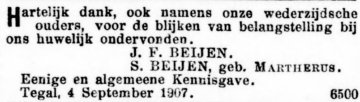 They had four children. The marriage ended in divorce in 1920. In 1926 Johan Franco remarried, to Nji Mas Soehaemi (Imik). They had one son. Moved to the NetherlandsAfter Indonesian independence, Johan Franco, like many Dutch people from the Dutch East Indies, applied for a Dutch passport. The upper part of the application is shown below.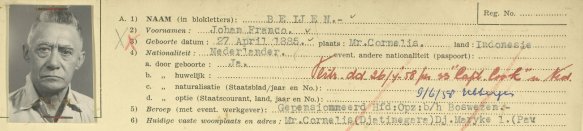 At the end of 1951, however, he opted for Indonesian nationality. In the 1950s, some of his family members moved to the Netherlands. Johan Franco himself initially remained in Indonesia with his wife, but in 1958 he eventually came to the Netherlands, together with a daughter-in-law and two grandchildren. They first lived in South Limburg, and from 1959 onwards in Bergen op Zoom. His wife remained in Indonesia. In 1960 Johan Franco regained Dutch nationality through a naturalisation act in which he was included together with a number of others. The explanatory memorandum to the bill described his situation as follows: The applicant Johan Franco Beijen, mentioned in Article 2, paragraph 1, was born in Djatinegara (Indonesia) in 1885 and is Dutch by birth. From the age of eighteen until his retirement in 1934, he worked for the Forest Service. For social reasons, the applicant opted for Indonesian nationality in December 1951. He has lived in our country since May 1958. The applicant receives support. He has agreed that, by explicit provision of law, Dutch nationality will be withheld from his wife, who resides in Indonesia. Below is a photograph of Johan Franco from 1962. 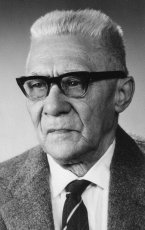 He died in Bergen op Zoom in 1969. The five children of Johan FrancoOf Eduard (13.6), the eldest child of Johan Franco, all that is known is that he received a technical education. He was born in Soekaboemi in 1909 and died in Tjimahi (now Cimahi) near Bandung in 1932 from a twisted intestine. He was only 23 years old.The other four children are discussed below: Henriëtte, Rudolph, Christiaan and Willem. Henriëtte (Smith-)Beijen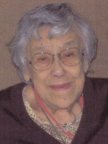 Henriëtte (Jet) Beijen (13.7) was born in Tjiandjoer (now Cianjur) in West Java in 1910. In 1936 she married Christiaan (Chris) Smith in Tegal in Central Java; he was a teacher and headmaster. They had six children. After the war, the Smith-Beijen family came to the Netherlands. They settled in Zaandam. In the Netherlands, Christiaan Smith worked as a technical draughtsman. He died in 1996. Jet died in 2007, almost 97 years old. Rudolph Beijen, killed in 1944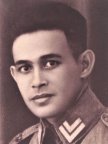 Rudolph Beijen (of Beyen) (13.8), the second son of Johan Franco Beijen, was born in Tegal in Central Java in 1912. In 1929 he joined the KNIL. He subsequently rose to the rank of sergeant-major instructor. He was taken prisoner by the Japanese in March 1942. In September 1944 he was transported, together with about 6,500 other prisoners, on the transport ship Junyo Maru. They were American, Australian, British and Dutch prisoners of war and Javanese forced labourers. The Japanese transported them to Sumatra under inhumane conditions to work on the Pekanbaru railway. 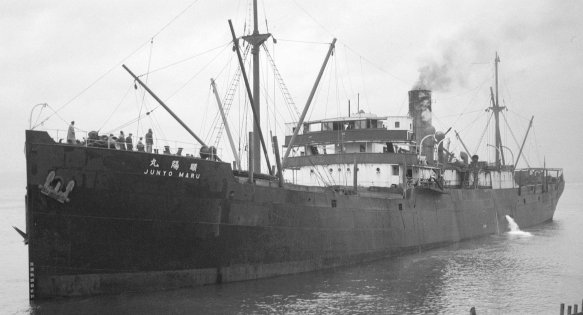 The Junyo Maru (shown above in a photograph from 1933) was torpedoed and sunk west of Sumatra by a British submarine. Only a small number of the prisoners survived. Rudolph Beijen was one of the thousands who died in the disaster.
 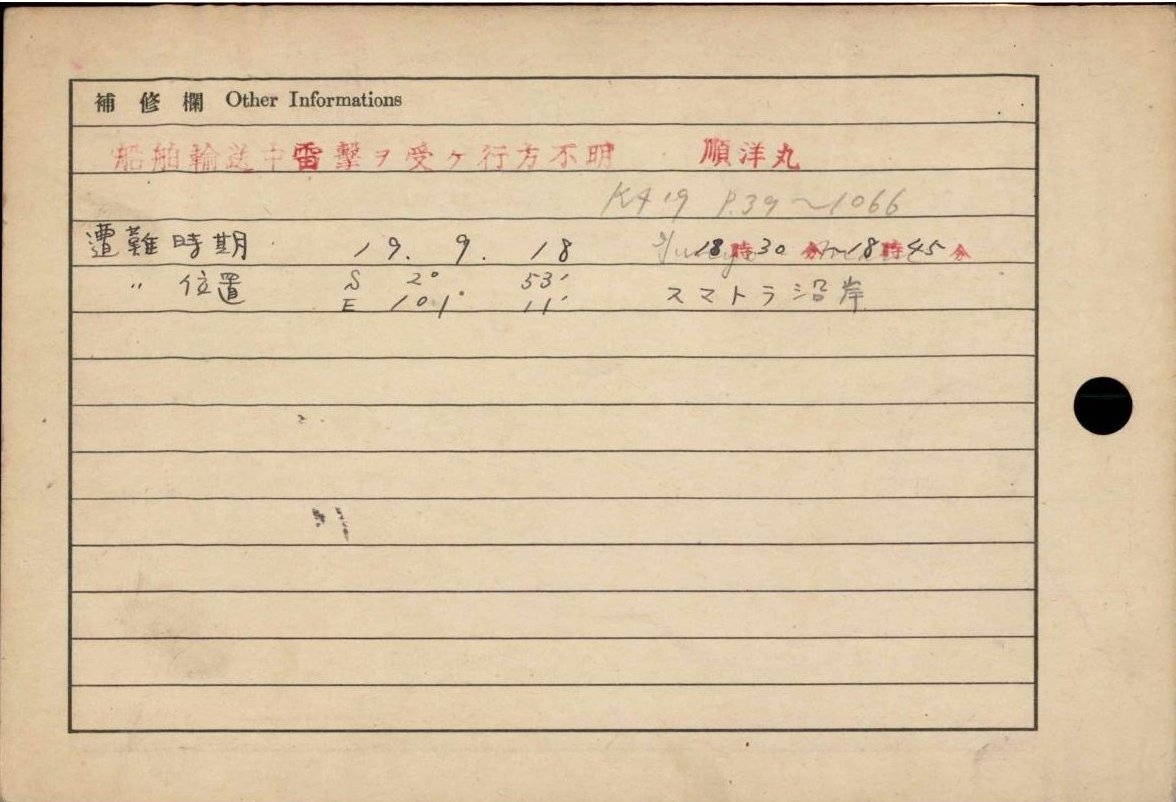 According to the Japanese text on the back of the card, Rudolph was captured on 8 March 1942. He was first held in the prisoner-of-war camp near Bandung and later in the one near Batavia. The exact time and location of the sinking of the Junyo Maru are given as: 18 September 1944, 18:30 - 18:45; 2º 53' South, 101º 11' East. In February 1938, Rudolph Beijen married Margaretha Jeanne (Greet) Rijnenberg in Pontianak on Borneo. They had three children: Ilse (1938), Ron (1940) and Henk (1942). Henk was born when his father had already been in captivity for more than six months.
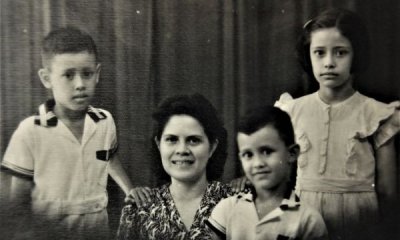 After the war, the situation in Indonesia became increasingly difficult for the family. In 1958, Greet and her children Ilse and Henk left for the Netherlands. Her son Ron had already departed earlier, having gone with the family of his aunt, Jet Smith Beijen. They lived first in South Limburg and subsequently in Bergen op Zoom. Greet passed away there in 1988.
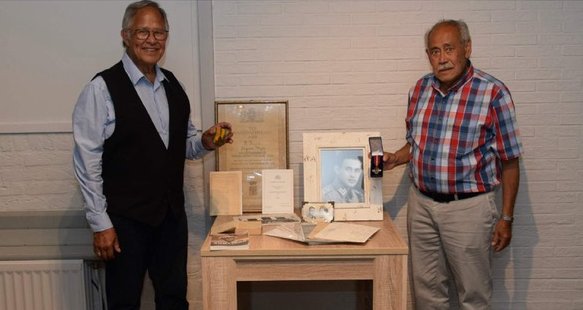 Rudolph Beijen's children have struggled all their lives with the loss of their father, whom they barely knew.
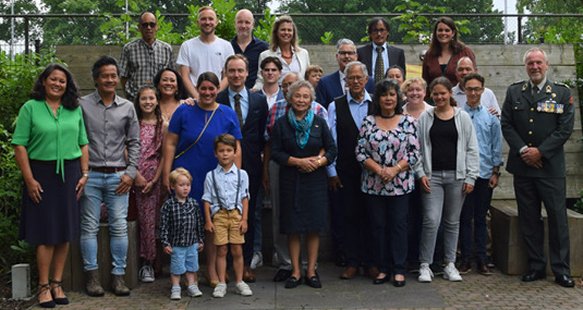 In this photograph, Ron Beijen is in the centre, just visible behind his wife Nancy Beijen-Eman. Henk Beijen and his wife Joyce Beijen-Brodie are standing to their right. All five of Ron's children were present: Paula Versteden-Beijen (far left), Franky Beijen (top row, left), Jeffrey Beijen (top row, second from right), Roy Beijen (next to Paula) and Cindy Beijen (two places to Roy's right). Henk's two children were also there: Danny Beijen (next to the general, with little hair) and Femke Beijen (just above her mother Joyce). Christiaan Beijen, former prisoner of war Christiaan Beijen (13.9) (known as Chris) was born in Tegal in 1914. Like his father Johan Franco, Chris worked as an inspector for the Forest Service. In January 1942, Chris married Jenny Boogaard in Soerabaja (now Surabaya). By then, war with Japan had broken out. He was called up by the Netherlands East Indies Army and stationed in Bandung with the motorcycle dispatch riders. The army retreated across Java but soon surrendered. Chris then went to his grandmother in Tegal. In June 1942, Chris and Jenny's first child, Victor, was born. The Japanese later arrested Chris after all. He was transferred to Padang on Sumatra to work on the Pekanbaru railway. The front and back of Christiaan's Japanese internment card:   According to the Japanese text on the front of the card, Chris was arrested on 15 January 1944. After the Japanese surrender in August 1945, he was able to return to Java. He was called up by the army again and stationed with the motorcycle dispatch riders in Batavia. His wife and young son had been interned by the Japanese in the Tjideng women's camp near Batavia. After Chris had collected them, they first went to Surabaya and later to Borneo. There he again worked for the Forest Service. Because of anti-Dutch measures in Indonesia, Chris moved with his family to Dutch New Guinea around 1952. When that territory was transferred to Indonesia in 1962, he went to the Netherlands with his wife and their four children. Chris Beijen and his wife both died in Rotterdam in 1997. Willem Beijen, emigrated to America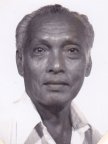 Willem Beijen (13.10), the only child of Johan Franco's second wife, was born in Poerwakarta in West Java in 1919. In 1947 he married Luci Angelique Pitton in Djakarta. She was born in Soerabaja in 1915 and had been in a Japanese prisoner-of-war camp for more than two years. They had four children, the first of whom died young. In Indonesia, Willem worked as a pilot, among other roles. In 1952, he and his family moved to the Netherlands, where they lived in Vlissingen. There, he worked as a cook at an officers' club. In 1960, they emigrated to the United States, first to California, and later to St. Louis, Missouri. Willem worked as a stationary engineer. In his later years, Willem moved with his wife to Fort Lauderdale, Florida, where he passed away in 2001. Luci passed away in 2004 in St. Louis. Family visit from AmericaIn September 2024, Eduard Beijen and his wife Kathy from Kansas City and Nancy Burkett-Beijen and her husband Robert from St. Louis spent a few days visiting family in the Netherlands. Eduard (born in Bandung in 1950) and his sister Nancy (born in Vlissingen in 1958) are a son and a daughter of the aforementioned Willem Beijen.Eduard had last met some members of the Beijen family in 1956. He could only remember his grandfather Johan Franco, who was very strict. Nancy had last visited the Beijen family in Bergen op Zoom in the mid-1970s. On 7 September there was a gathering in Bergen op Zoom attended by many of their Dutch relatives. The photograph below was taken there.  The members of the Beijen family are identified by a letter: A and B: Eduard (14.15) and Nancy (14.16) from America. C: Ron (14.7), a son of Rudolph, who was born in 1912. D, E, F, G and H: Ron's children Paula, Frank, Jeffrey, Roy and Cindy (15.4-15.8). I: Henk (officieel Rudolph Hendrik, 14.8), another son of Rudolph. J and K: Henk's children Danny and Femke (15.9-15.10). L and M: Frouke (14.11) and Raymond (15.11), a daughter and a grandson of Christiaan, who was born in 1914. The others in the photograph are partners, children and grandchildren. |
|
The next page The homepage The overview of the site |
The top of the page Searching this website Comments or questions |