| The Beijen/Beyen Family Site by Laurens Beijen |
 |
|
The homepage The overview of the site The next page The previous page |
The list of first names The photo gallery Searching this website Comments or questions |
Henricus Hubertus Beijen and the Haarlem PawnshopHenricus Hubertus Beijen (4.7) was born in 1805 in Nijmegen as a son of Gerardus Beijen who was mentioned at the end of the previous page. Therefore he was a grandson of Remigius. His family name and that of his children and grandchildren was nearly always written as Beijen, contrary to the prevailing use of Beyen in the later generations of the Nieuwkapelle family.At a young age, before he was twenty, Henricus moved from Nijmegen to Haarlem. In 1824 he was appointed youngest clerk of the Municipal Pawnshop of Haarlem. In 1826 he married the Haarlem-born Elisabeth van den Berg. In later years he rose to the position of deputy cashier of the pawnshop, the second employee in rank. In 1852 a large-scale fraud in the pawnshop was uncovered. It led to a great upheaval in Haarlem. Henricus was one of the suspects, but according to the court there was no legal proof of his guilt. He was therefore acquitted. After this unpleasant affair Henricus and his wife and children moved to Amsterdam, where they lived for many years. In 1881, after the passing of his wife, Henricus moved to Nijmegen, his birthplace. He died there five years later. Karel Hubertus BeijenFrom the marriage of Henricus and Elisabeth no less than twelve children had been born, but seven of them died in infancy. Only the youngest son, Karel Hubertus Beijen (5.17) had descendants in the Beijen-line.Karel was born in 1841 in Haarlem. In 1854 he moved together with his parents to Amsterdam. After his education at a grammar school he worked as an office clerk. In 1863 he married Jannetje Stenvers in Amsterdam. She was born in Amsterdam and was more than twelve years older than him.
Karel Beijen was the archivist of the NRS and an expert in railway legislation. In 1890 the NRS was taken over by the State and mainly merged with the State Railways. Karel Beijen became a department manager. He retired in 1908. 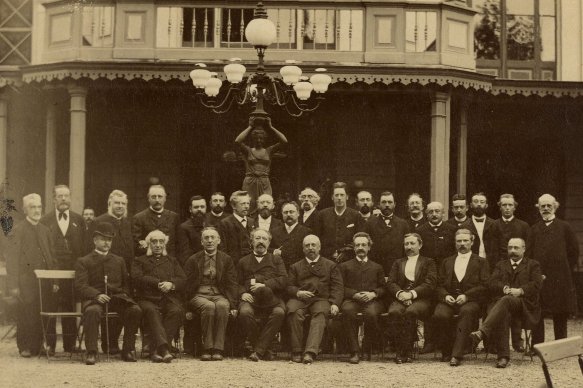 Karel Beijen was also active in an association promoting factory and handicraft industries in the Netherlands. The photo above was taken in 1889 during the celebration of the 25th anniversary of the association's Utrecht branch. Beijen is second from the left in the top row. Beijen also engaged in social affairs within the association. Together with another board member of the Utrecht branch, he published a report in 1886 on encouraging the construction of workers' housing by cooperative building societies. The authors expected that working together within such a cooperative would encourage workers to save. Karel Beijen's social-liberal stance was also evident in another cause he championed. During a meeting of his association in 1886 in Amsterdam, he advocated for workers' insurance against industrial accidents. This insurance should be paid for by employers. Fifteen years later, in 1901, the Accident Insurance Act was introduced. It was the first social security law in the Netherlands. Karel Beijen passed away in 1915, his second wife Antoinette Ramaer in 1922. Karel Hendrik BeijenThe eldest son of Karel Hubertus, Karel Hendrik (6.3), was born in 1866. He studied law at the Utrecht University. In 1890 he obtained his doctorate with a thesis on the Dutch nationality in relation to the international law. Below is a picture of him at a young age.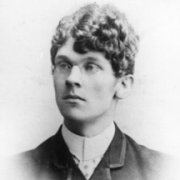 After his studies he held at first positions at the Ministry of Finance. In 1895 he was in the wake of his father employed by the State Railways. He made a very fast career: in 1899 he was appointed secretary of the company and head of the Central Division. This made him the immediate superior of his father. The relationships are illustrated by the next diagram that shows the salaries of Karel Hendrik, his father and his brother in guilders per year. 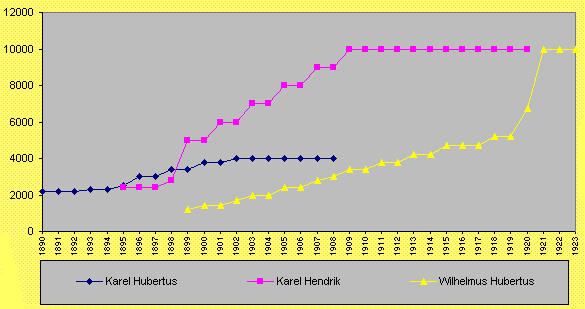 He resigned in 1920 from the State Railways. In later years he was an independent consultant for railway companies.
Wilhelmus Hubertus BeijenWilhelmus Hubertus (6.4) was born in 1869. Just like his father and his brother he had positions at the State Railways. The diagram above shows that his career was more gradual than his brother's. From 1921 until his retirement in 1933 he was chief of the employees funds of the Dutch National Railways.Wilhelmus Hubertus was married to Catharina Elisabeth van Rijkom. They had no children. As well as his brother, Wilhelmus died in 1941. |
|
The next page The homepage The overview of the site |
The top of the page Searching this website Comments or questions |